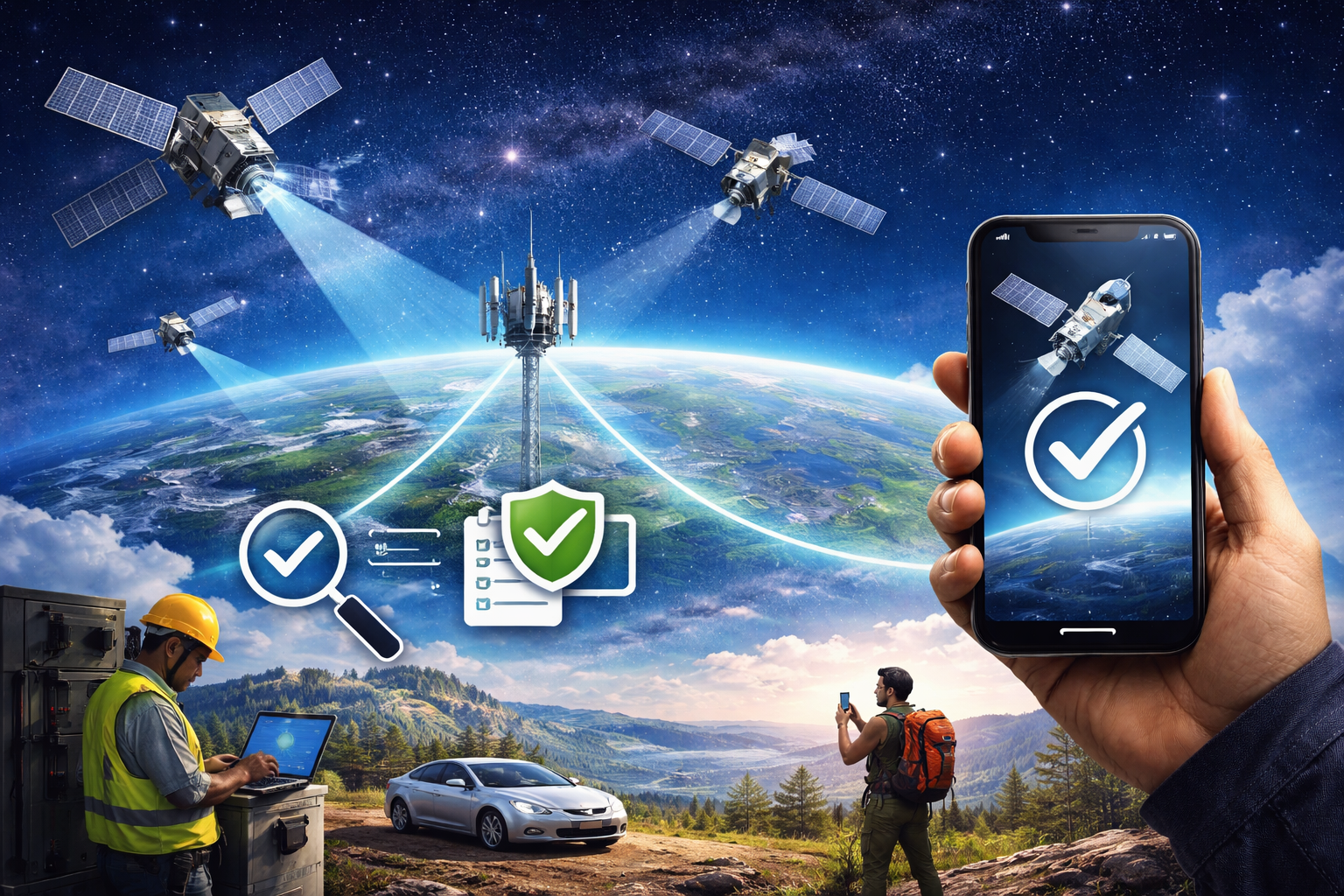
Satellite-to-mobile has moved from a futuristic concept to a commercial reality.
What was once talked about as a moonshot is now becoming part of the real telecom roadmap. Direct-to-device and direct-to-cell services are rolling out, satellite constellations are expanding, and the industry is racing toward a new era where terrestrial and non-terrestrial networks work together as one connected fabric. GSMA says the market focus is now firmly on direct-to-device, while commercial services such as Starlink Direct to Cell and T-Mobile’s T-Satellite are already live in select markets.
That is exciting.
But it should also raise a red flag for everyone in the ecosystem.
Because in telecom, breakthrough technology only matters when it performs in the real world.
And in satellite-to-mobile, the real world is unforgiving.
Unlike traditional terrestrial networks, satellite-enabled mobile services must deal with long delay paths, moving coverage areas, mobility complexity, hybrid handovers, quality-of-service constraints, and the challenge of making multiple layers of infrastructure behave like one seamless network. 3GPP has already identified key NTN issues, including mobility management over large and moving satellite coverage areas, satellite delay, QoS over satellite access and backhaul, and multi-connectivity across hybrid terrestrial-satellite environments.
That means the opportunity is enormous, but so is the risk.
The telecom industry is entering a moment where performance failures will not be hidden in the lab. They will be exposed in the field, in aviation, maritime, industry, emergency response, remote operations, connected vehicles, and underserved regions where connectivity is not a luxury but a lifeline. ESA and GSMA have highlighted that the industry is now actively pushing innovation around direct-to-device, 5G/6G testing hubs, and tighter satellite-terrestrial integration.
At the same time, the stakes are getting even higher because this is no longer just about coverage.
It is about the infrastructure layer of the AI economy.
UN Trade and Development projects that the global AI market will reach $4.8 trillion by 2033. McKinsey argues that telecom operators could provide the backbone for that economy if they can position themselves effectively within the AI infrastructure stack. In other words, the next generation of AI will not run on compute alone. It will depend on data movement, low-latency transport, resilient network access, and integrated infrastructure from cloud to edge to fiber to wireless to satellite.
That stack is becoming clearer by the day.
AI cloud platforms sit at the top. Edge AI data centers bring intelligence closer to users and machines. Fiber provides the transport backbone. 5G and, eventually, 6G extend intelligence across terrestrial networks. And multi-orbit satellite systems help close the last gaps, extending connectivity into oceans, skies, industrial corridors, rural zones, and disaster-affected areas where terrestrial coverage alone cannot do the job. 3GPP’s NTN roadmap and the industry’s current direct-to-device push both point in the same direction: integrated connectivity is no longer optional. It is foundational.
But integration is exactly where complexity multiplies.
A hybrid network is not just a bigger network. It is a more fragile one unless it is rigorously validated.
Can a device move smoothly between terrestrial and satellite coverage?
Can service levels remain stable under changing latency conditions?
Can operators trust performance under load, across geographies, and across use cases?
Can providers launch with confidence, knowing the customer experience will match the promise?
These are not marketing questions. They are testing questions.
And this is where quality assurance becomes a strategic advantage.
At RCATSONE, we believe the winners in satellite-to-mobile will not simply be the companies that launch first. They will be the companies that validate best. They will be the companies that understand that every new layer of connectivity introduces new failure points, and that service assurance must evolve just as quickly as the technology itself. RCATSONE’s own positioning emphasizes end-to-end validation, real-time reporting systems, and satellite-to-mobile testing aimed at compatibility, performance optimization, and compliance across hybrid environments.
The industry does not need more hype.
It needs confidence.
It needs proven interoperability.
It needs real-world performance validation.
It needs testing frameworks built for hybrid terrestrial and non-terrestrial networks.
It needs partners who understand that the future of telecom is not just broader coverage, but assured coverage.
Satellite-to-mobile is exploding because the vision is compelling: connectivity anywhere, intelligence everywhere, and infrastructure that can support the next generation of digital services.
But as this market accelerates, one truth is becoming impossible to ignore:
The future will not be won by the boldest claims. It will be won by the networks that work.
And in the trillion-dollar AI era, quality assurance is no longer a support function.
It is mission-critical.